We humans love to label and categorize things. Be it animals, plants or historical periods, we like to see the world ordered and compartmentalized neatly into concepts that we can arrange and rearrange, that we can control.
The same applies to arts where we slap labels of style and genre on to works whose creators may not have intended or wished for any labeling of their art.
Myself, I’m always happy when I come across a work of art that cheerfully defies any labels and categories.so When I learned that two of Ireland’s absolutely most brilliant musicians, Cormac McCarthy and Aoife Ní Bhriain, are releasing an album together, I was immediately excited.
I had witnessed Aoife playing with the legendary harpist Catrin Finch at Celtic Connections a couple of years ago and they both completely blew me away. So, as I already had witnessed her in amazing musical dialogue with another extraordinary musician, I had high hopes for this whole new collaboration.
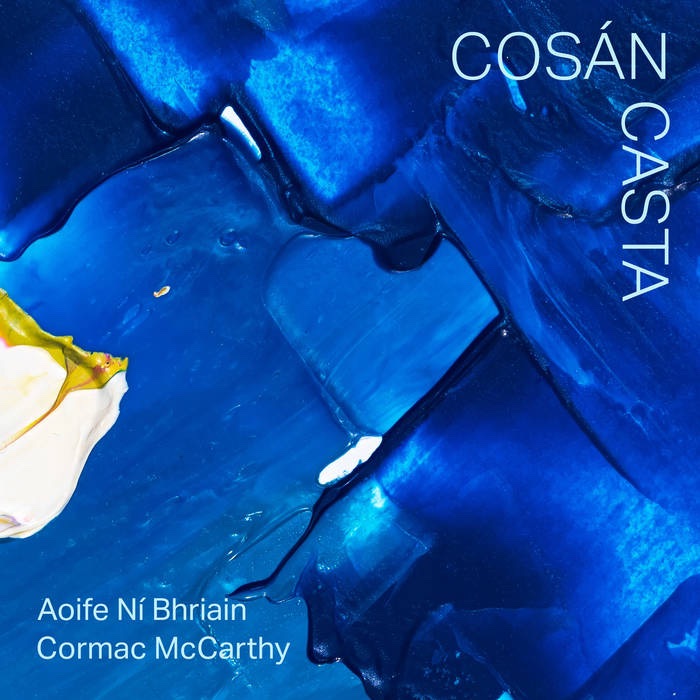
As the album’s information material tells me, Cosán Casta (a twisting or complicated path) is a mix of the old and the new, some of the music written for the album, some reimagined from old Irish tunes. And I use the word reimagined deliberately because it’s not just a matter of arrangement.
There are so many levels of excellence here it’s almost staggering. First, both Aoife and Cormac are long renowned virtuosos of their instruments, but what makes them both so interesting is their effortless crisscrossing between the worlds of classical and jazz and traditional music.
Note, for example, how Aoife uses the earthy fiddle/trad sound for most of the album but, at times, switches to glorious violin/classical voicing, re: the title track and the album finale, Salamanca. In this, she reminds me of my fellow Finn, the violinist Pekka Kuusisto, whose career is also characterized by frequent genre hopping and who was one of the guest artists on Su-a Lee’s album Dialogues.
Of course, the mastery of their instruments would not be enough to make this music so special. One element that makes Cosán Casta so fascinating is the way the Irish tradition is creatively and imaginatively molded into something new and vibrant without losing touch with the roots and the soil of this music.
And then they have the fantastic of freedom from labels and genres. You might, and probably would, say that what Aoife and Cormac are doing here is a fusion of traditional and jazz and classical, but that would really only describe the raw ingredients and not the cake, so to say. Because the music they have created here is, in a way, in a universe of its own; it exists as it is.
Expertly recorded by Ben Rawlins in a church over three days, the the interplay between the piano and the fiddle/violin creates an almost visual experience in your head in its clarity, if you concentrate on the music and use quality headphones that will give you all the detail and extraordinary dynamics that these two virtuosos create together.
I love how there is so much space in this music and between the instruments while at the same time it’s actually quite intense as well, with every note and every ornament coming across as meaningful.
Considering the overall amazing quality of the material, it’s essentially pointless to pick out any individual tunes, but I have to say it’s the longest pieces, Coffee Club and Gallagher’s Frolics, which connect with me particularly strongly.
This is just about as good as music can get; it makes me grateful to be alive to experience it. And now it’s your turn to dive in.

 FolkNotes